ES6 classes concepts
- Using Class, we reuse logic i.e creating multiple similar objects.
- A field is a variable that is declared directly in a class or struct. ... Properties enable a class to expose a public way of getting and setting values. A get property accessor is used to return the property value, and a set accessor is used to assign a new value.
// (public class method)
- here , it is returing function objects instead of value. This is because we are only passing function name instead of method in console.log(show).
- Classes are infact a function :" Special functions". In JS, there is not CLasses concepts but the thing is there is only J.S objects .
- console.log(typeof Mobile); // functions
- "Here , Constructor is a special method for creating and initalizing object created within a class
- There can be only one constructor within a class"
- if, you don't specify constructor method , a default constructor is used.
- That , means in above code snippet you were overriding default constructor.
Inheritance is a mechanism in which one class acquires the property of another class. For example, a child inherits the traits of his/her parents. With inheritance, we can reuse the fields and methods of the existing class. Hence, inheritance facilitates Reusability and is an important concept of OOPs.
Types of Inheritance
There are Various types of inheritance:
Single Inheritance:
In Single Inheritance one class extends another class (one class only).
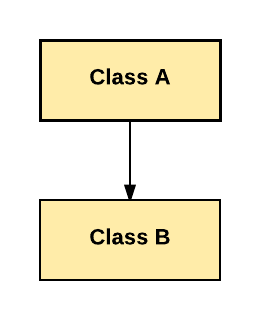
In above diagram, Class B extends only Class A. Class A is a super class and Class B is a Sub-class.
Multiple Inheritance:
In Multiple Inheritance, one class extending more than one class.
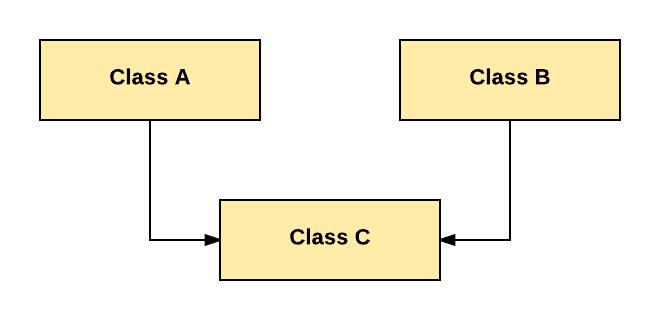
As per above diagram, Class C extends Class A and Class B both.
Multilevel Inheritance:
In Multilevel Inheritance, one class can inherit from a derived class. Hence, the derived class becomes the base class for the new class.

As per shown in diagram Class C is subclass of B and B is a of subclass Class A.
Hierarchical Inheritance:
In Hierarchical Inheritance, one class is inherited by many sub classes.
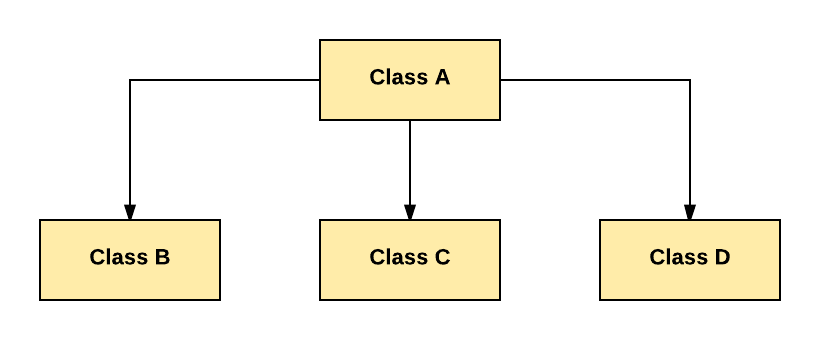
As per above example, Class B, C, and D inherit the same class A.
Class inheritance :
- The extend Keyword is used in class declarations as a class expressions to create class which is child class of another class.
- The extends Keyword can be used to subclass custom classes as well as built-in objects like Date, string, Array.
Inheritance with constructor in parentClass:
Inheritance with super Keyword concept: Constructor in both parent and child :
Using super keyword :
- the problem is : now we have initalize constructor in both the classes but the fact is we cannot access property of father with class object. so use of super keyword is prime.
- "it is responsilbiltiy that derived class must be initalized with super class constructor"
Method overriding:
- Same function name with different implementation
- Method Overloading is a feature that allows a class to have more than one method having the same name, if their argument lists are different.
Let’s have a look at the following example:
    function addNumbers(n1, n2, n3) {    return n1 + n2 + n3;}
function addNumbers(n1, n2) {    return n1 + n2;}
var sum = addNumbers(1, 2, 3);
" If overloading worked correctly the value of sum would be 6. However, as JavaScript doesn’t support overloading, the value of sum is something else."
"JavaScript supports overriding not overloading, meaning, that if you define two functions with the same name, the last one defined will override the previously defined version and every time a call will be made to the function, the last defined one will get executed. Looking at the above example, the value of sum will be equal 3 instead of 6."
STATIC Method :
- is used to define static method for class
- called without creating object and cannot be called through class instance
- With this we can conclude that static method depends only upon class, not the object.
- Are often used to create Utiltiy function for an app
"Static methods are generally utility methods or just general purpose methods that don't belong to any instance but instead to a class itself. They take in most inputs through arguments.
For example:String.valueOf()
This method converts various things to a String object. The method is a static one, meaning that it belongs to the String class itself. You cannot call it as a method of any String object because it doesn't modify or use the properties of an existing String in any way - it only takes an input and returns a new String. "
" A (usually) static method. Used when you need to do stuff that does not need an instance of a class.
Example: A math class has an add function. That function needs no state to operate on, only two numbers to add. It doesn't need to touch any of the member / instance variables of the math class, so it's preferable to make it static, rather than member"
Object configuration : property getter and setters
There are two kinds of properties.
- The first kind is data properties. We already know how to work with them. All properties that we’ve been using until now were data properties.
- The second type of properties is something new. It’s accessor properties. They are essentially functions that work on getting and setting a value, but look like regular properties to an external code.
obj.propName is read, the setter – when it is assigned.- From outside, an accessor property looks like a regular one. That’s the idea of accessor properties. We don’t call
user.fullNameas a function, we read it normally: the getter runs behind the scenes.
As of now,
fullNamehas only a getter. If we attempt to assignuser.fullName=, there will be an error:
- Let’s fix it by adding a setter for
user.fullName:

Comments
Post a Comment